Do Synpodial Orchids Ever Bloom Again
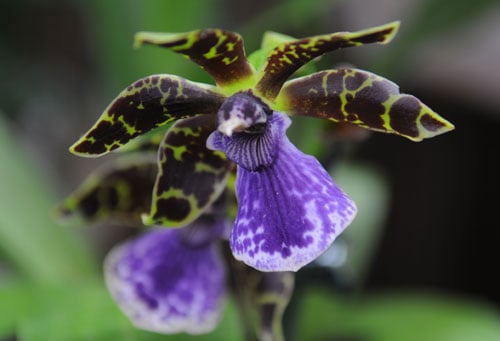 A zygopetalum orchid blooms in the Gardener'due south Supply greenhouse.
The beauty, complexity and incredible diverseness of orchid flowers are unrivalled in the constitute world. These exotic beauties comprise the largest family unit of flowering plants on globe, with over 30,000 unlike species, and at least 200,000 hybrids. Orchids can be institute in the equatorial tropics, the arctic tundra, and everywhere in between. The reason for this diversity lies in the orchid'southward astonishing ability to adapt to its given environs. With then many different orchid varieties that thrive in then many different growing conditions, it is relatively easy to find an orchid that is well suited to the conditions that yous can provide — whether information technology is a kitchen window or a full-size greenhouse.
Most cultivated orchids are native to the tropics. In their natural habitat, they attach themselves to the bawl of trees, or the surface of other plants. Their thick, white roots are specially adapted to blot moisture and dissolved nutrients. Because these tropical orchids normally grow loftier in the trees, rather than on the woods floor, they are accepted to practiced air apportionment and plenty of light. They prefer a 12-60 minutes day, all yr-circular, and crave a high intensity of light — near the aforementioned equally midsummer conditions in temperate regions.
Are orchids difficult to grow? Many of them are. In fact, some are about impossible to keep alive, much less bring into flower—even for professional growers. Only there are dozens of varieties of orchids, and hundreds of hybrids, that are perfectly happy growing on a sunny windowsill or under lights.
For your best crack at success, start by choosing one of the less fussy varieties that is adapted to the type of growing conditions yous can provide. Purchase the most mature plant you can afford (young plants are much more difficult to please), and, if possible, buy it in bloom, and then yous'll know what y'all're striving for.
How Orchids Grow
Orchids are usually grouped into two broad categories that characterize their growth habits. Monopodial orchids take a single, upright stem, with leaves arranged opposite each other along the stalk. The flower stem appears from the base of the uppermost leaves. Orchids with this growth habit include the phalaenopsis and vandas.
The more than mutual growth addiction is sympodial. These orchids abound horizontally, sending out new shoots from the old rhizome. Leaves and bloom scapes form at the height of the new shoots. Many sympodial orchids form pseudobulbs, which are swollen shoots that store water and nutrients to help the found survive periods of prolonged drought. Sympodial orchids include cattleya, cymbidium, oncidium and dendrobium.
Orchids tin also exist classified by their native habitat, which gives an indication of the temperature, moisture and light levels they prefer. Orchids native to the humid torrid zone, such as phalaenopsis and paphiopedilum, adopt daytime temperatures of 73° to 85°F, with 80 to 90 percent humidity. They are happiest in an e or southeast window where the calorie-free is not besides intense.
Warm-climate orchids, including cymbidiums and dendrobiums, are accepted to an average temperature of 55° to 70°F, a steady supply of moisture, and proficient air apportionment. They are by and large happy in a south-facing window, though they may demand a little shading during high summertime.
Cattleyas and some oncidiums grow where days are dry out and relatively cool. They are able to tolerate a long dry season with temperatures of 80° or ninety°F, followed by a distinct rainy flavour. Their need for lite is loftier, so they should be placed in a sunny, south-facing window.
High-altitude orchids, such as masdevallia and epidendrum, grow in the cloud forests where boilerplate temperatures are lx° to lxx°F, and humidity is very loftier. These orchids prefer filtered lite that is non as well intense.
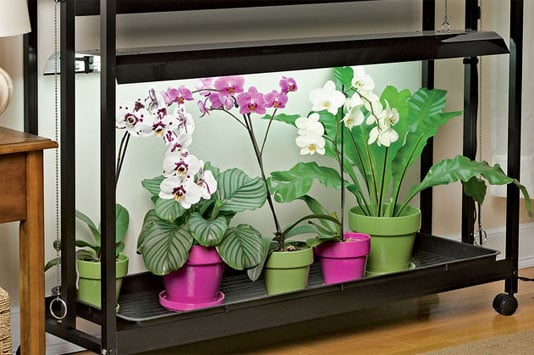 With three superbright, full-spectrum fluorescent bulbs per fixture, our LED High-Intensity grow lights provide 50 percent more light than dual-bulb versions.
Caring for Orchids
With 30,000 unlike species of orchids, information technology is impossible to give general care and cultivation instructions. Nevertheless, how an orchid looks can provide clues to its preferences for low-cal, h2o, and growing medium.
If the plant has few leaves, or leathery leaves (like most cattleyas and oncidiums), it's likely the plant needs a loftier-light environment. If the leaves are soft and limp (like some phalaenopsis and most paphiopedilum), the plants are probably very calorie-free-sensitive, and should not be placed in a sunny southward-facing window.
If the orchid has fat pseudobulbs, it should be watered sparingly, and should be grown on fibroid chunks of bawl or lava rock. If the orchid has no pseudobulbs, it may require more frequent watering, or should be grown in a more wet-retentive growing medium, such as sphagnum moss.
Shop for LED grow lights
Light
Every bit a full general rule, orchids are lite-hungry plants. For all-time results, they should become 12 to 14 hours of calorie-free each day, year-round. In a tropical environment, the duration and intensity of natural light does non vary as it does in temperate climates. For this reason, you lot may demand to move your orchids effectually, and supplement with artificial calorie-free to keep them happy during the winter months.
South- and east-facing windows are usually the best spot for orchids. West windows can be too hot, and northern ones are usually too nighttime. If you don't have a skilful window location for your orchids, they volition be perfectly happy growing under bogus lights. Orchids should be positioned no more than 6 to 8 inches away from a set of 4-foot fluorescent bulbs. Opinions vary as to the benefits of cool white, warm white, and grow low-cal bulbs. The new total-spectrum bulbs are probably the best all-around choice. Some orchids with very loftier light requirements, such as vandas and cymbidiums, may need high-intensity discharge lighting in order to bloom. For more information, read Growing Under Lights.
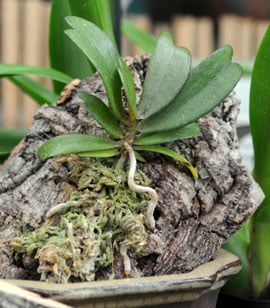 A tiny orchid trained to grow on a piece of bark.
Growing media
Terrestrial orchids, such as paphiopedilums and some cymbidiums, grow in soil. Merely nearly tropical orchids are epiphytes, which ways that they grow in the air, rather than in soil. Their fleshy roots are covered with a layer of white cells called velamen, which acts as a sponge to blot h2o. The coating as well protects the roots from heat and moisture loss.
An orchid growing medium must provide good air circulation and let h2o to drain very quickly. It must also requite the roots something secure to cling to. Depending on the blazon of orchid, they can exist happy growing in peat moss, fir bark, dried fern roots, sphagnum moss, rock wool, perlite, cork nuggets, stones, coconut fiber, lava rock or a alloy that combines several of these materials. Some epiphytic orchids can also exist wired onto slabs of tree fern or cork. Every bit a general rule, fir bawl nuggets are the well-nigh popular growing medium.
Watering
Most orchids tin can tolerate drought far improve than they can tolerate excess moisture. Zero kills an orchid faster than letting it sit in a water-logged pot. Without adequate air circulation, the constitute will suffocate and dice.
As a very full general rule, orchids should be watered once a week. The growing medium should exist immune to dry out between waterings, and backlog water should non come in contact with the roots or the growing medium. After existence re-potted, most orchids will non resume active growth for several months. Water very sparingly during this readjustment period.
 Specially designed orchid pots make information technology easier to keep plants watered properly.
Humidity
Nearly tropical orchids prefer humidity levels of 60 to 80 percent. With the winter-time humidity level in near homes hovering closer to xxx per centum, orchid growers oft utilise a humidifier, or set their orchids on rubber grids set in waterproof trays or gravel-filled trays filled with only enough water so information technology doesn't bear on roots. Some orchids also do good from beingness misted.
Fertilizer
Orchid-growing mediums provide very few nutrients, so orchids must be fertilized to sustain healthy growth. Employ a liquid fertilizer, and dilute it more than than you lot would for other plants. Fertilizer should but be applied when plants are in agile growth. This means that virtually orchids should not be fertilized in midwinter, or right afterwards they have been re-potted. Many growers apply a xxx-10-10 fertilizer, though others prefer ten-ten-10 or 10-10-30. Misting your orchids with fish emulsion or seaweed extracts will provide micronutrients.
Shop for orchid supplies
Potting and Re-Potting
Orchids are usually happiest in a relatively small pot. Plastic pots are preferred because when information technology's time to re-pot, the roots can be more easily discrete, or the pots tin can simply be cut apart. To ensure adept drainage, you lot can fill the bottom inch or two of the pot with foam "peanuts." Suspend the orchid over the pot, and gradually fill the pot with fir bawl chunks or whatever other growing medium y'all are using. The crown of the plant should be just a fleck below the top of the pot. Sometimes information technology's helpful to use a bit of wire to secure the plant until its roots get established.
Some orchids should be re-potted every year. Others may exist happy in the same pot for seven or more years. Equally a full general dominion, don't re-pot your orchid unless necessary. Orchids resent existence disturbed. Re-pot if the growing medium has started to break down enough to reduce aeration; if the roots are creeping out well beyond the pot; or if new growth has unbalanced the plant.
Propagation
Propagating orchids from seed is quite hard. Different the seeds of other plants, orchid seeds exercise not contain nutritional storage tissues. To abound, the seed must land where it will notice a particular kind of fungi that tin can penetrate its root system and convert nutrients into a usable course. To overcome the odds, an orchid seed capsule typically disburses millions of microscopic seeds, which tin be carried hundreds of miles from the mother constitute.
To propagate orchids from seed, you must work in sterile conditions. The seeds must be grown in a gelled substance that contains nutrients and growth hormones. Yous must also be very patient. It takes months for the first leaves to develop, and, fifty-fifty then, they will merely exist visible with a magnifying glass. Roots appear even later. It will be at least three, and possibly every bit many as eight years earlier you see a flower.
It is far easier to propagate orchids by division. Just remember that dividing a constitute means forsaking blooms for at least a twelvemonth. Also, the larger the orchid plant, the more flowers information technology will produce. Pocket-sized divisions accept many years to mature.
Orchid Facts
Unlike other plants and animals, orchids can produce hybrids between species, and too betwixt related genera. This permits a heed-boggling number of hybrids, and is the reason for the very circuitous names given to about orchids.
- Most orchids bloom once a yr, but if they are actually happy, they may bloom more ofttimes. If you desire an orchid that blooms during a particular season, the all-time bet is to purchase a institute that is in flower at that time.
- When an orchid does flower it normally remains in bloom for half dozen to 10 weeks.
- Orchids resent re-potting, and usually will not flower for at least a year afterward they have been disturbed. If possible, purchase your orchids in pots, rather than bareroot.
Easy Orchid Varieties for Beginners
- Cattleya: Loftier light; 55 to ninety degrees F; 40 to fourscore per centum humidity; alternate wet and dry; coarse fir bark.
- Phalaenopsis: Brilliant light; 65 to 85 degrees F; 40 to 70 percent humidity; exercise not permit to dry out; medium fir bark.
- Paphiopedilum: Bright calorie-free; 50 to lxxx degrees F, depending on variety; xl to sixty pct humidity; continuous moisture; bark or fluffy moss mix.
Source: https://www.gardeners.com/how-to/growing-orchids/5072.html
0 Response to "Do Synpodial Orchids Ever Bloom Again"
Post a Comment